i
Memes, Mindworms, Memplexes &c. daniel-hromada ()


Memes, Mindworms, Memplexes &c.

How do ideas spread, mutate, and survive? Why do we laugh when others laugh, adopt accents, hum songs that refuse to leave our heads, or suddenly find ourselves saying "actually"? This seminar explores the evolution of information through the lens of theory of memes, also known as memetics—the study of how cultural patterns replicate, vary, and undergo selection. Beginning with genes and the logic of biological evolution, we trace the emergence of memes as cultural replicators transmitted through imitation, communication, and media. Along the way we examine mirror neurons, contagious behaviours, habits, dopamine, earworms and mindworms, the Maluma–Takete effect, memetic complexes such as fashion, ideology, and religion, self-referentiality, the formation of the egoplex, viral phenomena, computer viruses and worms, apps, emojis, memecoins, and other contemporary manifestations of cultural evolution. Combining perspectives from evolutionary theory, psychology, neuroscience, philosophy, linguistics, media studies, and computer science, the seminar invites participants to view culture itself as an evolving ecosystem of replicating patterns which often act and express themselves independently from what our bodies, minds and souls "actually" want.

Memes in Alltag

Session 0 · Memetics begins at home.

Before Internet memes, before ideology, before theory: gestures, tunes, habits, rituals, phrases, drawings, interfaces and everyday acts of copying.

Meme

“A meme is whatever is copied from person to person.”

— Susan Blackmore, working definition

For today, let us start with this deliberately simple definition.

Copied?

Copying does not necessarily mean making an exact duplicate.

You hear a joke.

You remember the structure, forget several words, change a character...

...and tell it to somebody else.

Something survived the transformation.

Two Worlds

external expression → perception → internal reconstruction → expression

A meme can appear outside us: as sound, gesture, image, text, object, ritual.

It can be reconstructed inside us: as memory, rule, association, expectation, intention.

Then it can become external again.

What exactly is being copied?

A Word of Warning

Memetics is a theory among other theories.

Human culture can also be studied through psychology, anthropology, sociology, cultural evolution, semiotics, media theory, neuroscience and many other perspectives.

Memetics highlights replication, variation and selection.

It does not explain the whole human being.

And although it may begin to look as if everything is a meme...

...it is not.

Not Everything That Spreads Is a Meme

A virus spreads. That does not make it a cultural meme.

Genes are copied. That does not make them memes.

You discover by yourself that fire is hot. No person-to-person copying was necessary.

A yawn may trigger another yawn through an evolved response rather than culturally learned imitation.

Spread alone is not enough.

Where Is the Meme?

Is the meme the sentence?

The idea expressed by the sentence?

The memory in somebody's brain?

The rule that allows the sentence to be reconstructed?

The pattern distributed across people, media and artifacts?

Different memetic theories answer differently.

Memethical Engineering

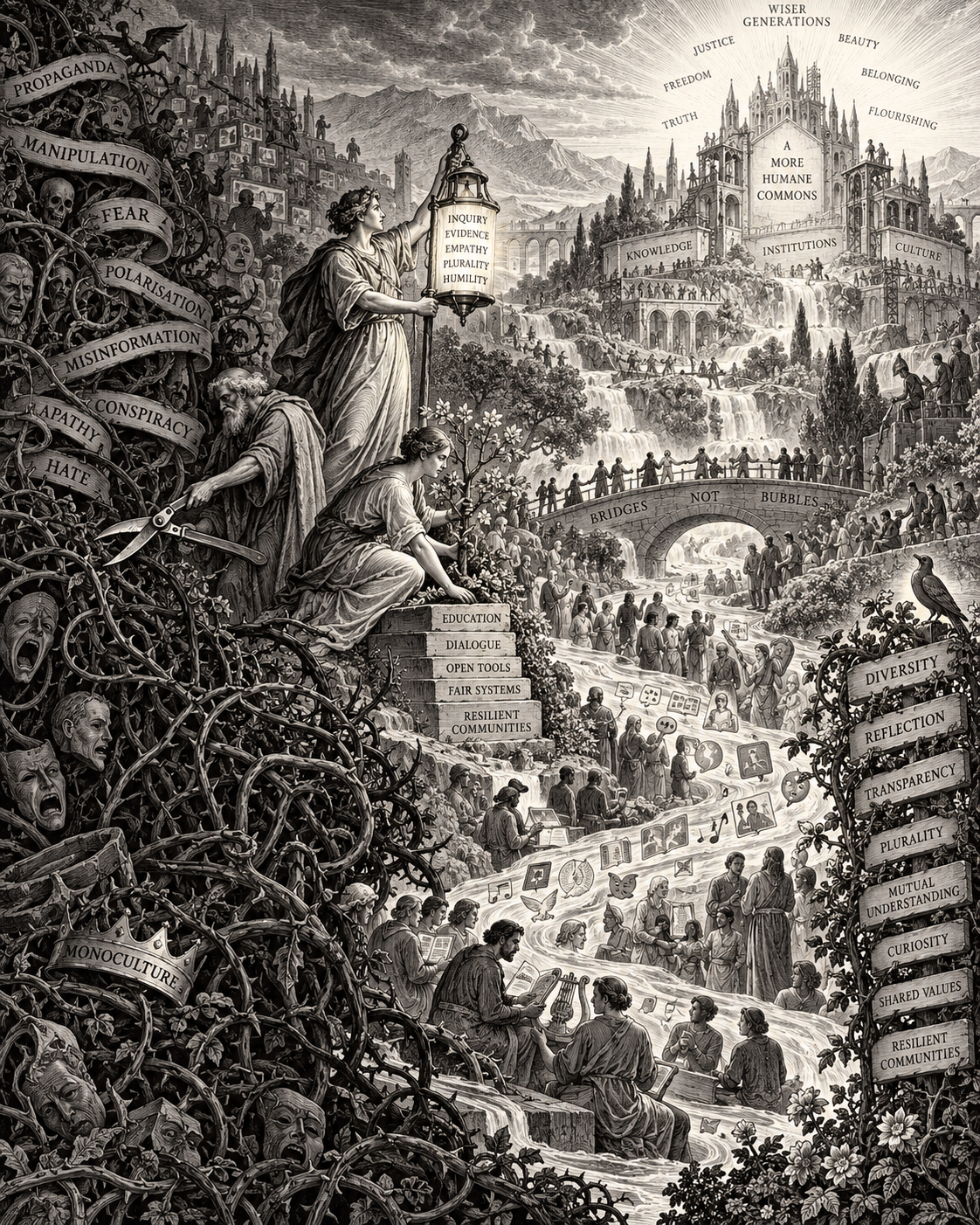
Memethical engineering is the deliberate design, modification, and circulation of memes and memetic environments in accordance with explicit ethical goals.

For example: counteracting propaganda and manipulation.

Increasing epistemic and cultural diversity.

Supporting critical reflection.

Increasing resilience against harmful or monopolizing meme complexes.

Engineering the Environment

Memetic engineering asks: How can this spread?

Memethical engineering must additionally ask: Should it spread?

Who benefits?

What disappears when it succeeds?

Can people recognize the mechanism?

Can alternatives survive?

Success ≠ virality.

Memes in Alltag

Let us now temporarily leave theory behind.

Look at ordinary life as a landscape of things passing from person to person.

We will move from the smallest and fastest patterns...

...toward increasingly complex cultural structures.

From Meme to Memeplex

Memes rarely live alone.

They support, trigger and protect one another.

A fashion includes clothes, vocabulary, gestures, music, places and identities.

A profession includes practices, jargon, values, rituals and status symbols.

Religions, ideologies, artistic movements and institutions can contain enormous interconnected systems of culturally transmitted elements.

Such complexes are often called memeplexes.

Exercise · Find One

Think of one meme you encountered today.

Not necessarily an Internet meme.

Where did you encounter it?

What was its external form?

What did you reconstruct internally?

Did you reproduce it?

Did you modify it?

Why might this particular pattern survive?

Memes in Alltag

A handshake.

A birthday song.

A stupid little drawing in a school notebook.

A phrase you suddenly notice yourself saying.

A floppy disk that survived its floppy disk.

A belief nobody remembers learning.

Culture replicates through us—but never without being reconstructed by us.

The Second Replicator

Replication + Variation + Selection = Evolution

Before Darwin

For most of human history, the diversity of life was explained by one simple idea: species are fixed, created once, unchanging.

A rabbit begets a rabbit. An oak begets an oak. World without end.

Even naturalists who classified thousands of species rarely asked: where did all this variety come from?

Darwin's Insight

In 1859, Charles Darwin proposed something radical: species are not fixed.

They change, slowly, over generations — new species arise from old ones through an entirely natural, unplanned process.

He called it natural selection.

No designer. No goal. Just a mechanism.

The Engine of Evolution

Replication + Variation + Selection = Evolution

Darwin never used these three words this way — but this is the abstract engine hiding inside his argument.

Three ingredients. Run them together, over and over, and something astonishing happens: design without a designer.

Replication

Something must be copied from one generation to the next.

Offspring resemble parents — not perfectly, but closely enough that traits persist.

Darwin did not know about DNA. He only needed: like tends to produce like.

Variation

No copy is perfect.

Within any population, individuals differ — in size, colour, behaviour, shape.

Some of this variation is heritable: it gets passed on, imperfections and all.

Without variation, there is nothing for selection to act upon.

Selection

Not every variant survives. Not every survivor reproduces equally.

Resources are limited; environments are demanding.

Whatever traits make an individual slightly better at surviving and reproducing become, on average, more common in the next generation.

Nobody chooses. The environment simply… filters.

Darwin's Finches

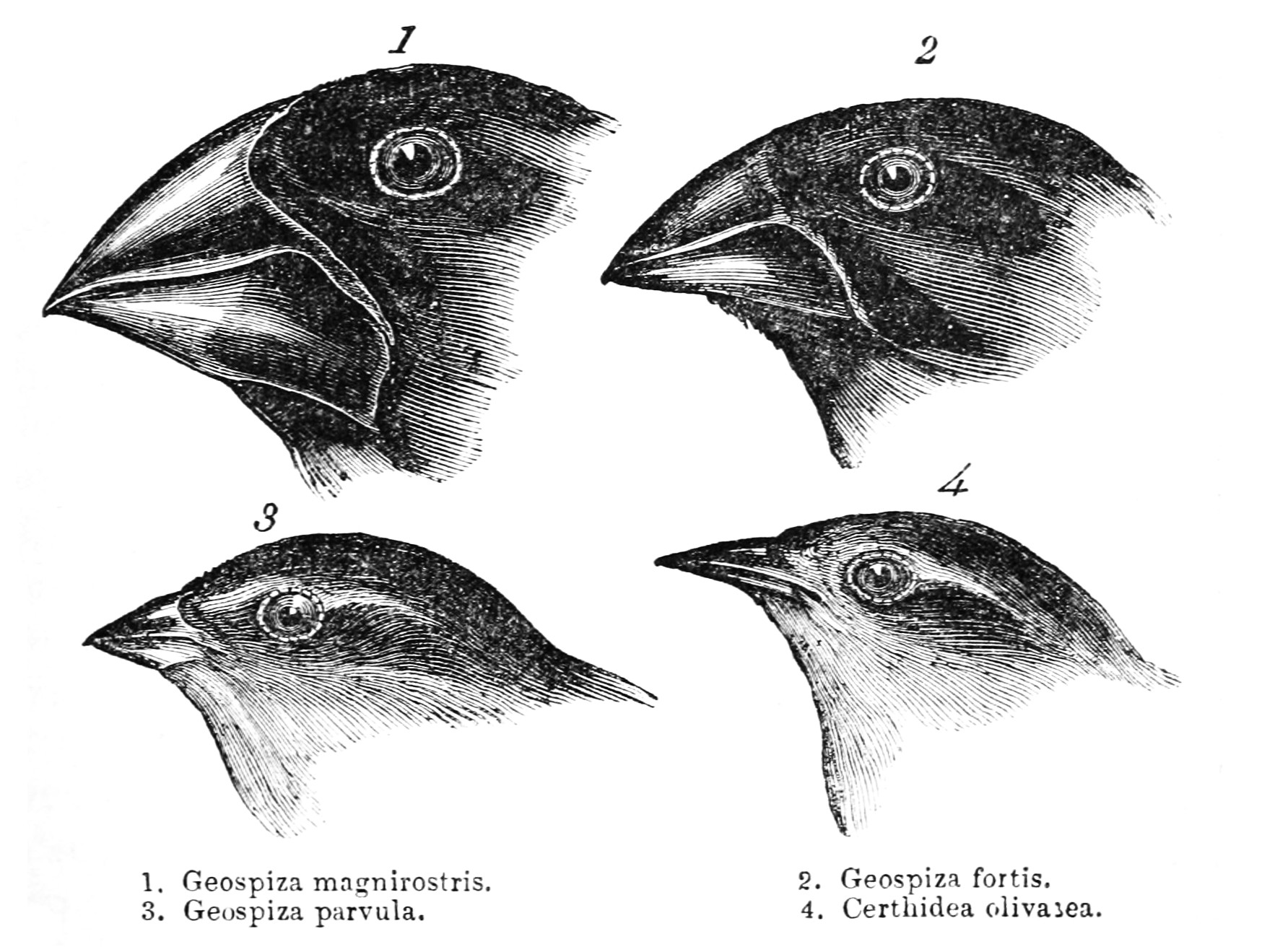
In 1835, Darwin collected small birds across the Galápagos Islands — a few hundred kilometres off the coast of Ecuador.

Back in London, ornithologist John Gould identified them: not varieties of one species, but more than a dozen distinct species of finch — found nowhere else on Earth.

Each island's finches had a differently shaped beak: thick and crushing, thin and probing, long and curved.

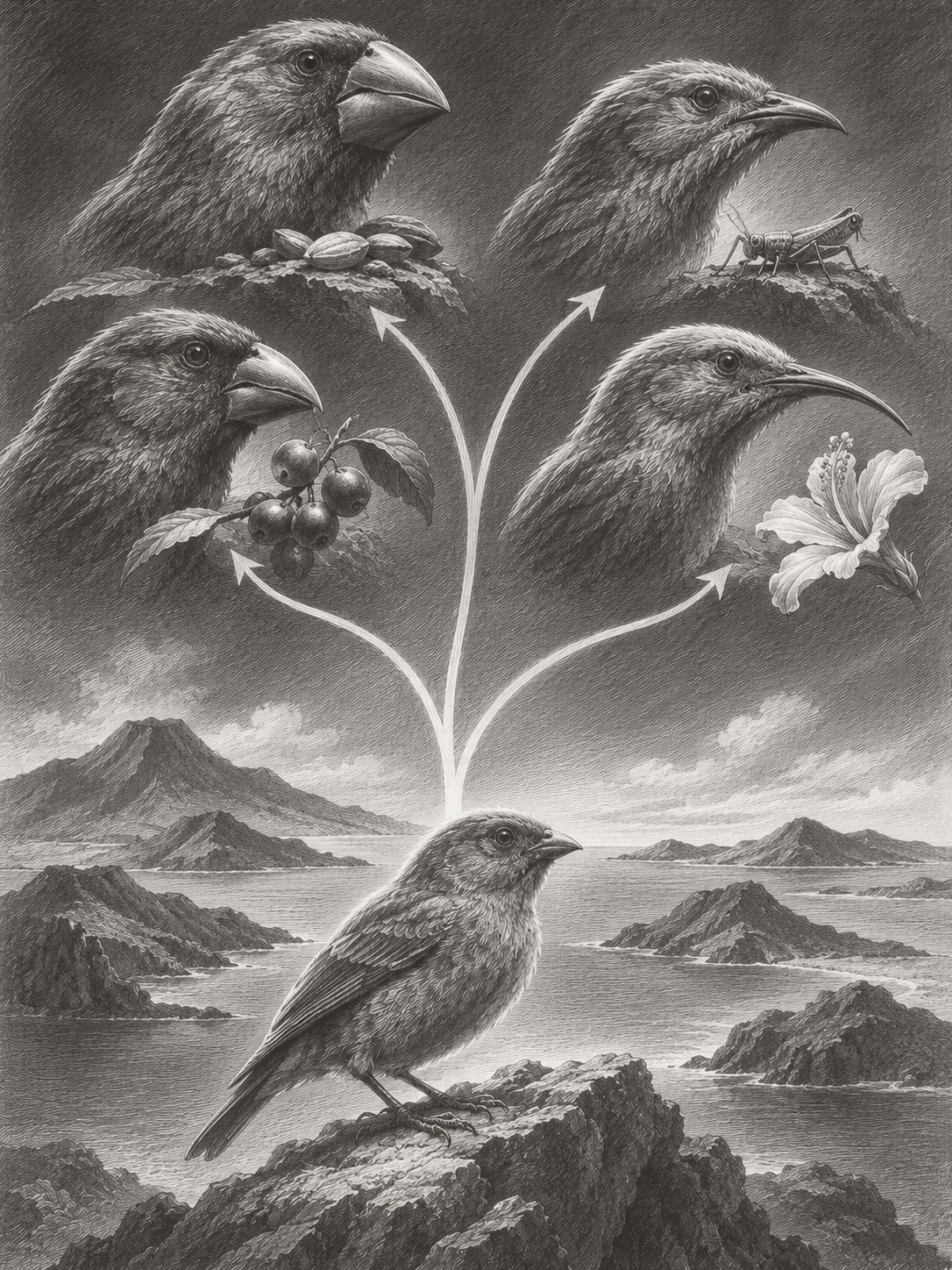
One Ancestor, Many Beaks

The beaks matched the food available on each island: hard seeds, soft fruit, insects, nectar.

Darwin's explanation: all the finches descended from a single ancestral species that reached the islands long ago.

On each island: beak-shape variation + a different food source + generations of selection → a different finch.

One ancestor. One mechanism. Many birds.

Why Finches Matter

The finches are not proof of evolution by themselves — but they are an unusually clean illustration of the engine in action, isolated on real islands, at a scale a visitor could actually observe.

Replication (finches breed finches), variation (beak shapes differ), selection (local food decides who thrives) — nothing more was needed.

So here is a strange question. Does this engine only run on carbon?

Universal Darwinism

Darwin described biological evolution. But notice: nothing in the three-step engine mentions DNA, cells, or carbon chemistry.

It only requires: entities that are copied, imperfectly, and then differentially filtered.

Richard Dawkins called this generalized claim Universal Darwinism: wherever you find replication + variation + selection, you will find evolution — in biology or anywhere else.

Beyond Carbon

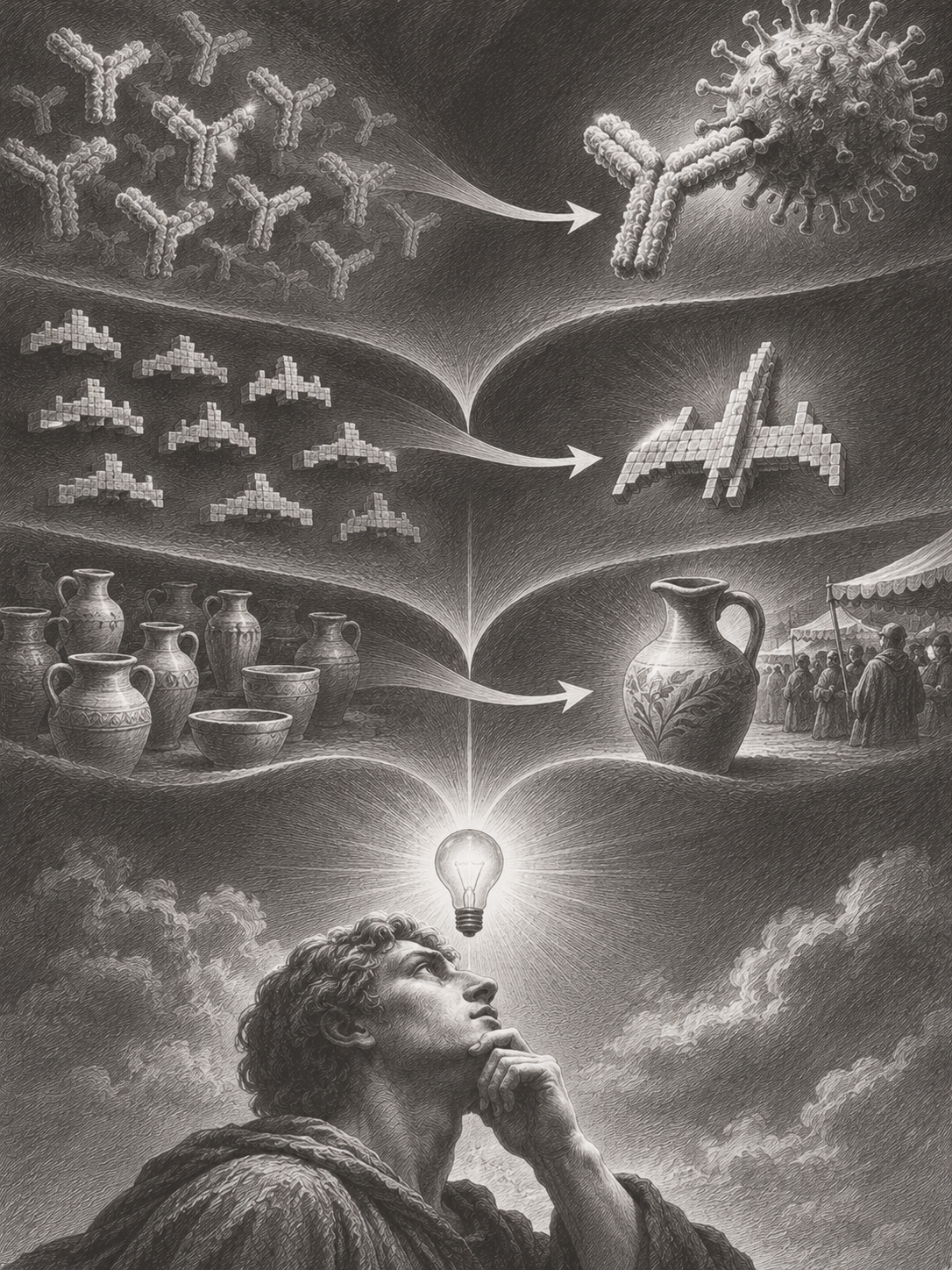
The pattern shows up again and again, once you know to look for it:

your immune system selects among antibody variants for the ones that bind an intruder;

computer scientists breed populations of candidate solutions in “genetic algorithms”;

markets select among competing products and firms.

Could the same be true of ideas themselves?

Dawkins' Reframing

In 1976, Richard Dawkins published The Selfish Gene — and reframed the whole story.

It is not organisms that are the true unit of selection, he argued. It is the gene.

“We are survival machines — robot vehicles blindly programmed to preserve the selfish molecules known as genes.”

The Altruism Puzzle

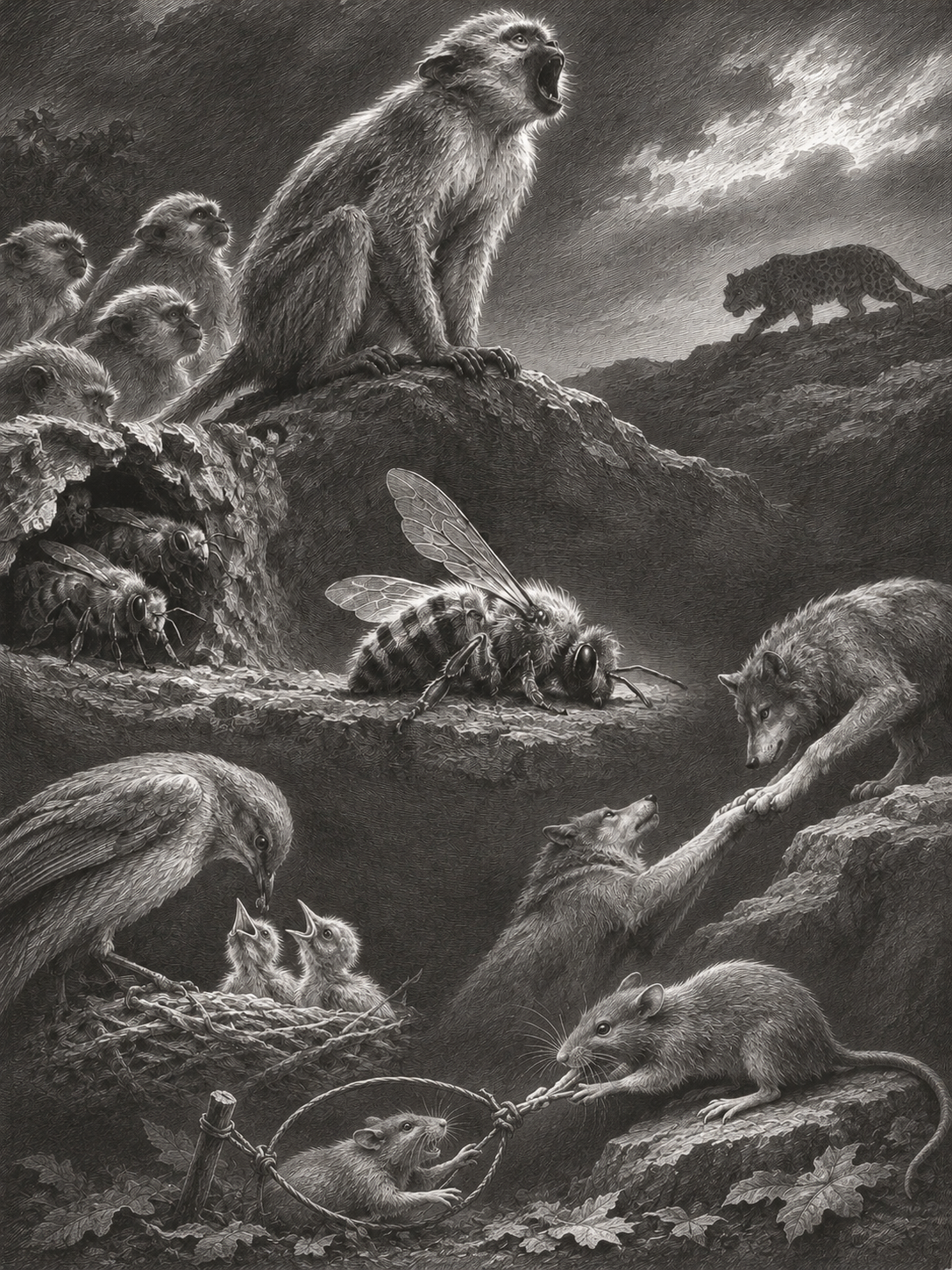
Nature is full of altruism — vervet monkeys shout alarm calls that draw a predator's attention to themselves, worker bees die defending the hive, parents starve so their young can eat.

Selection should ruthlessly punish that. An organism that sacrifices its own survival to help another should leave fewer copies of itself behind — so how does self-sacrifice survive selection at all?

Dawkins' answer: look one level down. Kin selection (W.D. Hamilton) — a gene for helping relatives can spread if it helps enough copies of itself in their bodies, discounted by relatedness. Reciprocal altruism (Robert Trivers) — helping a non-relative who is likely to help you back.

The organism can be generous because the gene is not — it is simply exploiting every available route to more copies of itself, kinship and reciprocity included.

Replicators and Vehicles

Two roles, easy to confuse:

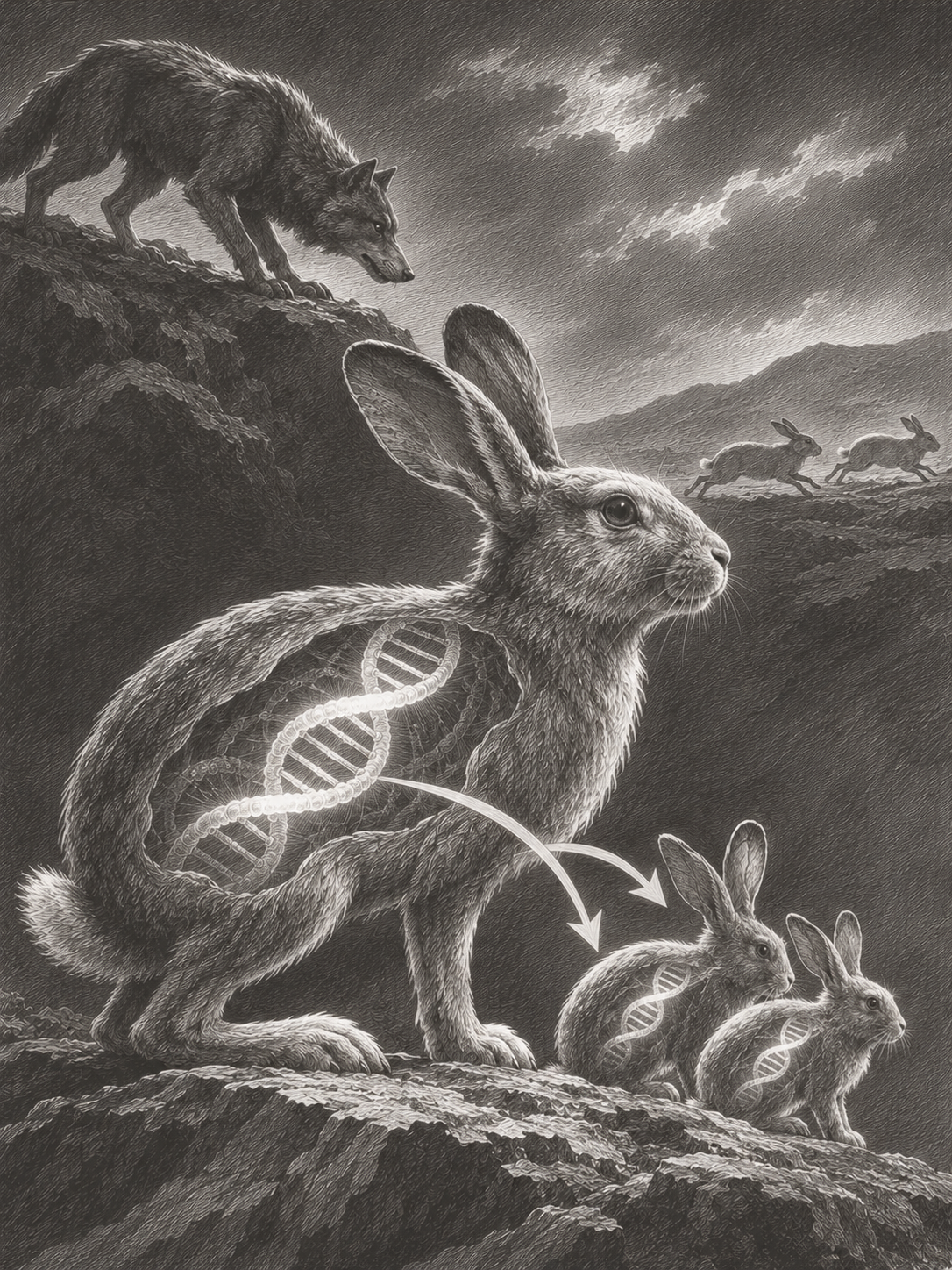
Replicator — the thing that gets copied. The gene.

Vehicle — the thing that is built, survives, and reproduces, carrying replicators inside it. The organism's body.

Selection acts on vehicles — but its lasting effect is on which replicators get copied into the next generation.

A Question Dawkins Asked

If the gene is just one possible kind of replicator…

…could there be others? Things that are copied, vary, and are selected — but are made of neither DNA nor protein?

Dawkins proposed there could. He needed just one more word.

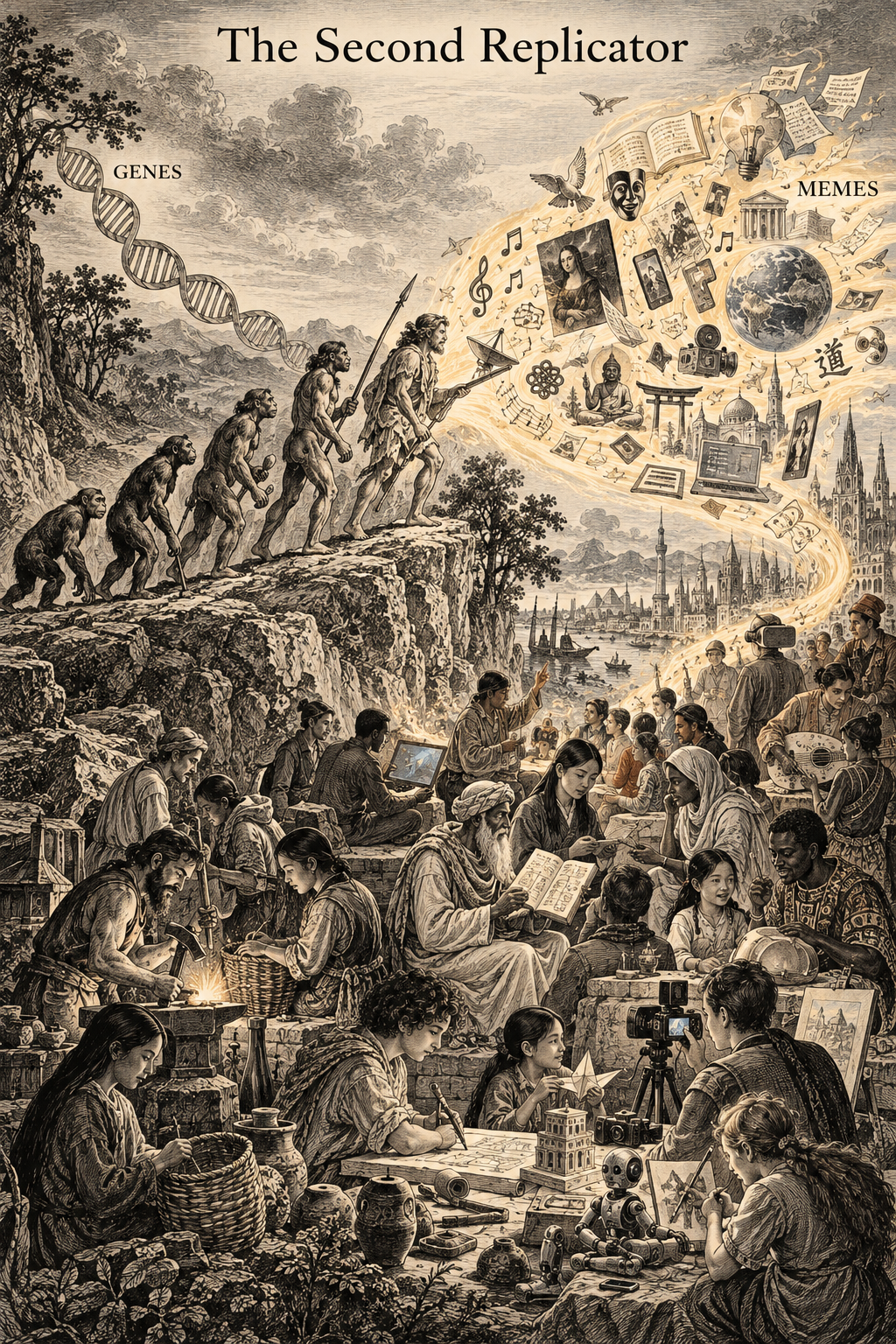
The Second Replicator

“I think that a new kind of replicator has recently emerged on this very planet… I shall call it a meme.”

— Richard Dawkins, The Selfish Gene, 1976

Tunes, catch-phrases, fashions, ways of making pots or building arches — copied from mind to mind, by imitation.

Genes and Memes Compared

Gene — replicated via reproduction; vehicle: the body; variation: mutation; selection: survival & reproduction.

Meme — replicated via imitation; vehicle: brains, books, screens; variation: mis-copying, reinterpretation; selection: attention, memorability, usefulness.

Same three-step engine. A completely different substrate.

Ideas in Motion

We began with finches on volcanic islands and ended with an idea that may be living, right now, inside each of you.

If memes are real replicators, then minds are their islands — and culture is the ongoing experiment.

In the sessions ahead, we will look much closer at how exactly this second replicator moves: through imitation, through everyday life, through law, politics, and the machines we now build.

Cultural evolution

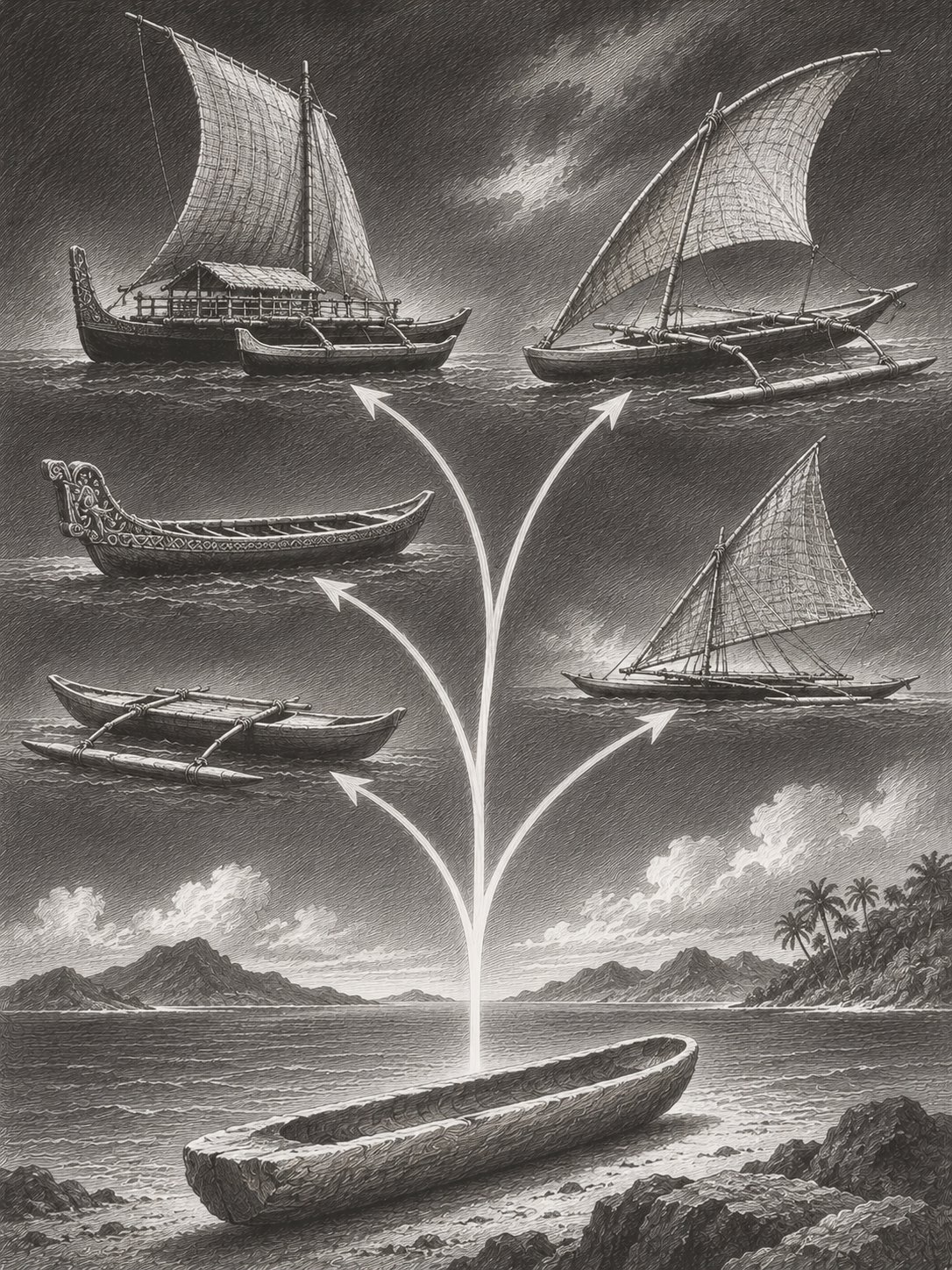
Oceania (Room 215)

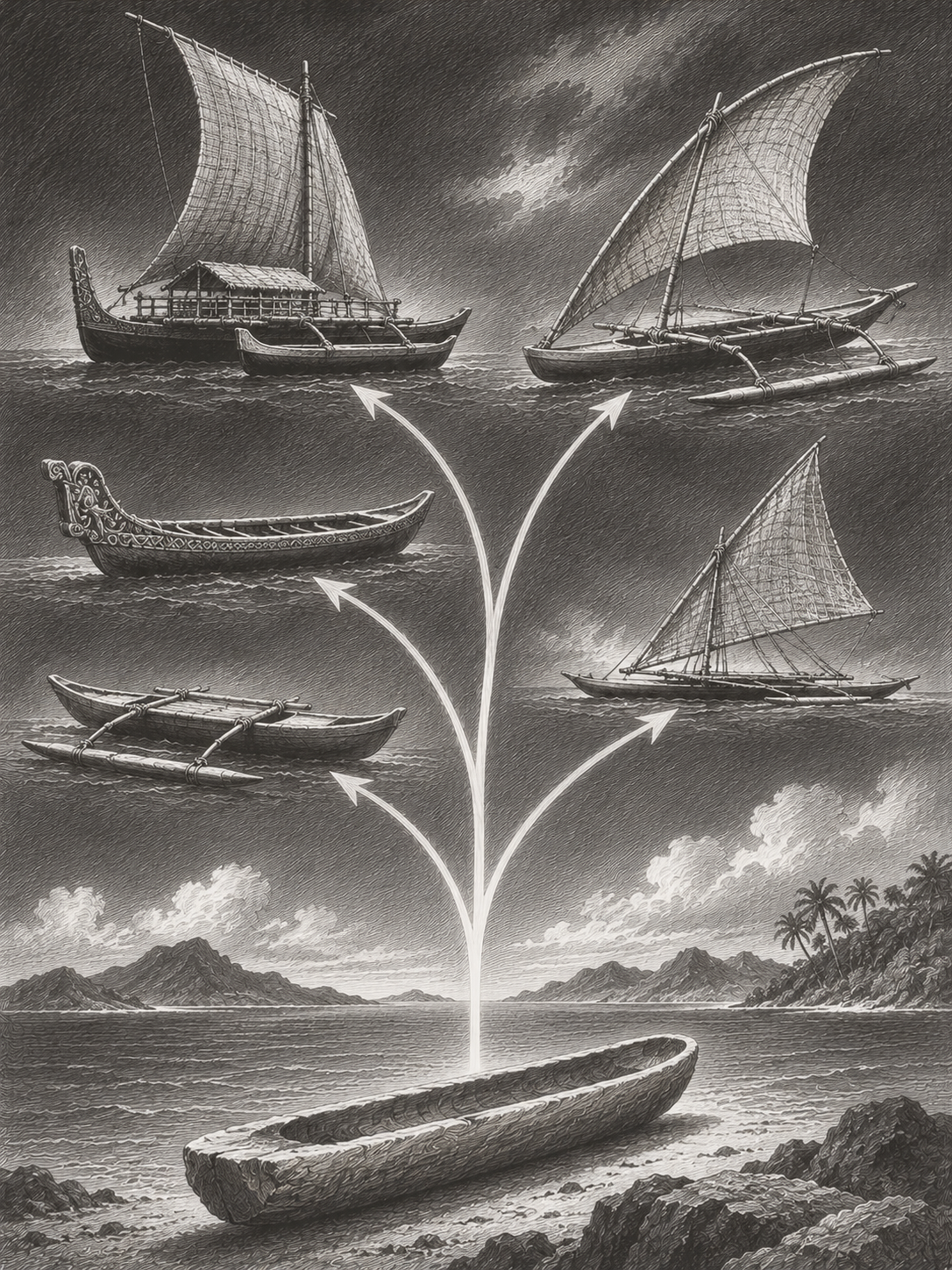
Do different ships and boats contain a recipe for their own construction / replication ?

How much information is missing, who and how provides it ?

How do different ships differ ?

Why do their differ ?

What does the process which results in "boat diversity" have in common with the process which results in "coral diversity" ?

Sounds of the world (Room 217)

Why do some sounds (= air vibration waves), some combinations of sounds (= melodies & harmonies) as well as artefacts whose function is to produce such sounds (= music instruments) appear and reappear in cultures all around the world ?

And what role do silence, rhythm and tempo play in this ?

Polynesia (Room 219)

Is cannibalism a meme ?

If yes, should (art)works spreading such memes be forbidden by Law ?

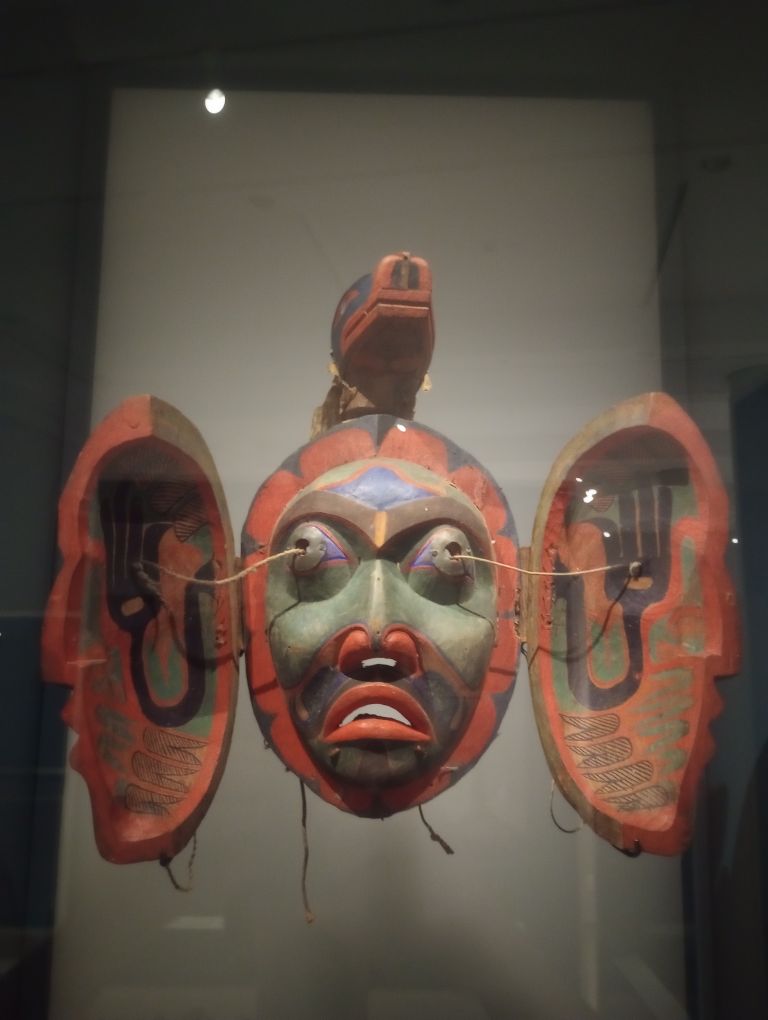
First nations (Room 202)

This is a transformation mask of Kwakwaka’wakw people, one among First Nations who practiced the gift-giving ceremony known as potlatch.

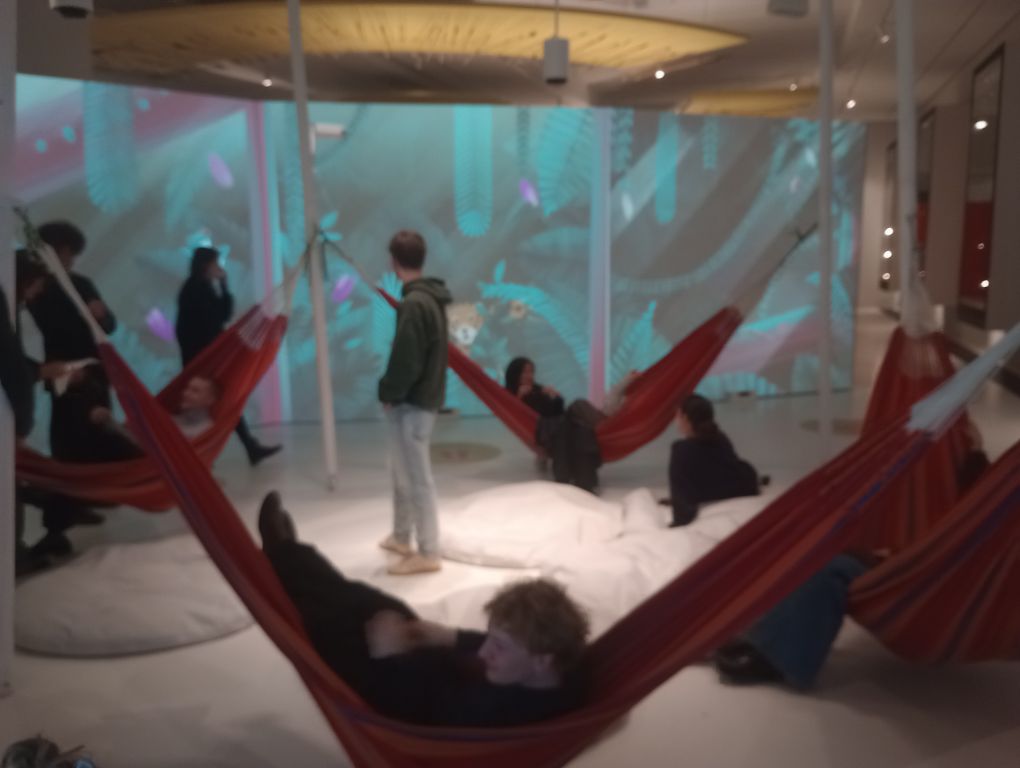
Amazonas (Room 206)

Want to have a hammock seminar ?

Starte eine Kampagne. Stelle ein Antrag. Genieße den Hängematteuntericht.

Imitation, social learning, dopamine &c.

Freud, Dawkins, Rizzolatti

MindBrain

The MindBrain is the living, learning, self-modifying system through which we perceive, remember, interpret and act.

Not just the brain. Not a ghost in the machine.

One thing: biology and mind, continuously reshaped by experience, action and other people.

Today's question: what does it copy — and what decides what it copies?

What a MindBrain can do

Copy — imitation, habituation & habit, memorization & recall

Change — plasticity, association, generalization, variation & recombination

Choose — attention, prediction, metacognition

Ten capacities. Each one is a door through which a meme can enter, mutate — or be thrown out.

Five roles in the memetic game

Host — it carries patterns it did not invent

Replicator — it repeats them: speech, gesture, drawing, habit

Mutator — it misremembers, reinterprets, recombines

Selector — it ignores most things and passes on a few

Product — its tastes and beliefs are partly made of memes

Same organ, five jobs.

Experiment · The Whispering Chain

Five volunteers. The first reads this text, hides it, and writes it down from memory for the next. Nobody sees the original.

On the third night the fox crossed the frozen river carrying seven blue apples, and nobody in the village believed the child who saw it.

We come back to it at the end.

Replicate · Vary · Select

Replication + Variation + Selection

Replication — imitation

Variation — play, curiosity, dreaming, forgetting, Fehlleistungen

Selection — Bandura says: mostly other people

True. But those people are primates with bodies. What do they select for?

A body first

Before it is a student, an artist or a meme host, the MindBrain belongs to an animal that has to:

eat

mate

stay safe

stay in the group — rank, grooming, coalitions, gossip: chimp-like business

Every meme has to get past these four gatekeepers.

Archetypes

“An instinctive trend.”

Jung: archetypes are inborn tendencies to form certain images — Mother, Child, Hero, Shadow, Trickster, Wise Old Man.

Not a blueprint, but a tendency. “As marked as the impulse of birds to build nests.”

Read memetically: archetypes are the MindBrain's pre-installed selection filters, the shape that food, sex, danger and tribe took in the imagination.

Stories that fit the filter spread. Stories that don't, die quietly.

Which memes win?

The ones that feed a need or press an archetype.

Food videos. Sex appeal. Outrage and threat. Gossip and rank. Belonging.

Hero stories, villain stories, the trickster's joke.

Think of the last thing you forwarded.

Which gatekeeper let it through?

Dopamine · wanting

Hebb: cells that fire together wire together. Dopamine decides which firing counts.

Dopamine is not the pleasure molecule.

It is the wanting molecule: go, get it, again. Liking is another system (Berridge).

Food, sex, safety, standing: the body pays for all four in the same currency.

It also teaches: it decides which connections get strengthened.

Dopamine · surprise and the herd

Dopamine reports better than expected, not reward (Schultz).

Expected and delivered: silence. Unexpected: burst. Expected and missing: dip.

That is how habits — and feeds — are built.

And a smile, praise, a good reputation, a like pay out in the same currency as food (Izuma).

A meme that predicts social reward gets copied.

Mirror neurons

See → do.

Macaque premotor cortex (Rizzolatti, Parma): the same neurons fire when the monkey grasps and when it sees a grasp.

A neural footprint of imitation: see → do.

Warning: popular claims race far ahead of evidence. Cecilia Heyes: mirror responses may themselves be learned, by being imitated.

The copying machine may be built by memes.

Prenatal · the first meme

Before any input: spontaneous kicks, spontaneous neural firing — variation with no outside cause.

From about the 25th week the fetus hears. Newborns know their mother's voice, prefer a story read to them in late pregnancy, and cry in the melody of their language.

Is the first meme a melody — and the first thing learned what is safe?

Infancy · the first selectors

Milk, warmth, a face: food and safety arrive bundled with a person.

Smile at six weeks. Serve and return. Tronick's still face: stop responding and the baby protests, then withdraws.

Do newborns imitate? Meltzoff 1977: yes. A 2016 study of 106 infants: no. Open question.

Parents are the first selectors — with the body's blessing.

Toddlers copy everything

Kuhl: nine-month-olds relearn Mandarin sounds from a live person — not from a video of the same person.

Over-imitation: children copy even useless steps. Chimps skip them.

Humans over-copy. That is how culture accumulates instead of leaking away.

Bandura

Bobo doll, 1961: children saw an adult hit it — and hit it too.

Model rewarded: more imitation. Model punished: less (1965).

Attention → retention → reproduction → motivation.

Even watching someone else's outcome fires prediction-error signals (Burke).

You can be selected without doing anything: by watching who gets punished.

Whom do we copy?

Those who look at us and speak slowly. The majority. The successful. The similar — same accent, same group.

Children track who has been right before.

Primate rules: rank, kin, coalition.

Selection is social because we are social primates.

Variation · play and curiosity

Play is copying with mistakes allowed.

Children explore more and exploit less than adults (Gopnik).

Curiosity pays: information itself is rewarded by dopamine.

Variation is not noise. It is the MindBrain paying itself to try something new.

Variation · dreaming and forgetting

Babies spend about half of their sleep in REM. Dreams remix what the day stored — why exactly, nobody knows.

Forgetting is fast: Ebbinghaus's curve. Before age three: almost nothing stays.

Bartlett: retell a story and it bends toward the teller's habits.

What we forget is also a selection — and a mutation.

Variation · Fehlleistungen

Versprechen, Verlesen, Vergessen, Verlieren: Freud's VER-.

Not random: a second plan breaking through the first.

Children say “goed” and “mouses”: a rule applied too well.

Mondegreens: “Lady Mondegreen” instead of “laid him on the green”.

A slip is a mutation where two patterns collide. Which one did you make this week?

Adolescence · sex and the herd take the wheel

Reward sensitivity peaks, self-control matures later.

Teens take more risks when peers watch (Chein). A “like” lights up the reward system (Sherman).

In Jung's language: Anima and Animus, the image of the other, are projected on real people.

Subcultures, slang, scenes: memeplexes with a sex- and status-engine.

Adolescence · the editor arrives

The prefrontal cortex keeps maturing into the mid-twenties.

Metacognition: I notice that I am copying.

Shadow: what I deny in myself I project onto others.

The host can learn to choose its diet.

Reveal and exercise

The last version of the chain versus the original: what dropped, what was added, what became more typical?

Which gatekeeper did it: food, sex, danger, group? Which archetype or story pattern?

Now find one meme from today.

Which need does it feed?

Take home

Replication: imitation, with a body that mirrors.

Variation: play, curiosity, dreams, forgetting, slips.

Selection: other people, driven by bodies that want food, sex, safety and the herd — paid in dopamine.

Questions, detours and objections welcome.

The Fascist Memplex: How Fascism Replicates, Mutates & Spreads

... and how to defeat it

Earworms, mindworms, moving memes::Fashion, Style, Art &c.

Earworms, mindworms, moving memes::Fashion, Style, Art &c.

Mediated memes, Urban memes

Mediated memes, Urban memes

Memplexes

Memplexes, Religions, Ideologies, Self-reference

Memes in Law, Politics & Propaganda

Memes in Law, Politics & Propaganda

Memes & Cyberspace

Memes & Cyberspace

Memes, Memecoins, AIs

Memes, Memecoins, AIs

Memes revisited

Memes revisited

The Congress

The Congress